Watercolor Vintage Patchwork Clipart Review
As a professional embroidery designer and product reviewer, I approach every new digital asset with a specific question: will this actually stitch out beautifully on fabric? When evaluating Watercolor Vintage Patchwork Clipart, my assessment goes far beyond the screen. While these illustrations are visually stunning as digital files, their true value for makers, Etsy sellers, and apparel decorators lies in their translatability to thread. This review breaks down how this collection performs in real-world embroidery projects, from custom apparel to boutique merchandise, based on practical design judgment rather than marketing hype.
First Impressions: Nostalgia Meets Stitch Potential
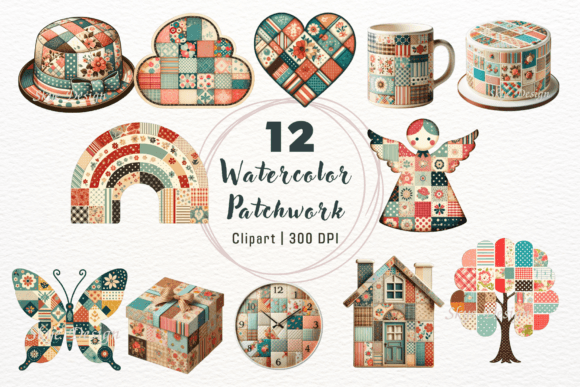
My initial reaction to the Watercolor Vintage Patchwork Clipart collection was one of cautious optimism. The aesthetic is undeniably charming, evoking a sense of heirloom quality and soft nostalgia that is currently trending in the handmade market. The color palette features muted tones and blended gradients typical of watercolor art, which presents both an opportunity and a challenge for machine embroidery.
Visually, the patchwork motif suggests texture and depth. For an embroidery project, this means the design relies heavily on the interplay between fill stitch areas and satin stitch borders. Unlike flat vector art, these illustrations have organic edges and internal shading. As a designer, I immediately started mentally mapping thread colors. The success of this clipart in a finished product depends entirely on whether your digitizing software or pre-digitized embroidery file captures those subtle watercolor transitions without creating excessive stitch density. If executed correctly, the result is a soft, painterly look that elevates a simple tote bag or sweatshirt into a premium personalized gift.
Real-World Application: The Custom Tote Bag Test
To truly evaluate this asset, I considered a recent client request for a vintage-style market tote bag. This scenario is perfect for testing the Watercolor Vintage Patchwork Clipart because canvas provides a stable base while demanding visual clarity. In this context, the clipart serves as more than just decoration; it acts as the focal point of the brand identity for a small shop product.
When applying this design to a natural canvas tote bag design, the patchwork elements need to feel tactile. I found that treating the individual "patches" within the clipart as potential applique design zones works exceptionally well. Instead of stitching out thousands of fill stitches to mimic the printed watercolor effect, using actual fabric scraps for the patchwork sections and utilizing running stitch or satin stitch outlines preserves the vintage integrity while reducing stitch count. This hybrid approach makes the commercial embroidery viable for production runs without sacrificing the artistic detail. Customers react positively to this mixed-media look because it feels authentically handmade rather than mass-produced.
For sweatshirt embroidery, however, the strategy shifts. Fleece and French terry fabrics have texture that can compete with delicate watercolor details. Here, the Watercolor Vintage Patchwork Clipart needs to be scaled appropriately. On a crewneck, I recommend centering the design and ensuring the thread colors have high contrast against the garment. Pastel threads on a cream sweatshirt often get lost; opting for slightly deeper, saturated vintage hues ensures the design assets remain visible and impactful in product photography and wearable use.
Navigating Fabric Constraints and Technical Limits
Not every surface is friendly to the nuanced style of these illustrations. Through experience, I have identified specific scenarios where Watercolor Vintage Patchwork Clipart requires careful handling:
- Stretchy Fabrics: When working on baby embroidery or performance wear, the open weave and stretch of the fabric can distort intricate patchwork lines. You must use a high-quality stabilizer, potentially doubling up or using a cut-away variety, to maintain registration.
- Dark Fabrics: Watercolor aesthetics rely on light passing through layers. On black or navy garments, the design can look muddy unless you employ a white underlay or choose a version of the clipart specifically optimized for dark backgrounds.
- Curved Surfaces: Cap embroidery is notoriously difficult for detailed patchwork. The curvature distorts horizontal lines. If using this clipart for hats, select a simplified element or resize the design to fit the flat frontal panel area strictly.
- Small Hoop Sizes: Reducing complex illustrations to fit a 4x4 hoop often results in lost detail. Tiny lettering or thin connecting lines in the patchwork may turn into perforations. Always verify the minimum recommended size before resizing.
Furthermore, consider the end-use care. A kitchen towel or apron faces frequent washing and abrasion. While the Watercolor Vintage Patchwork Clipart is beautiful, delicate satin stitch borders may fray over time on high-wear items. For these functional goods, I advise reinforcing edges or choosing a variation with denser border stitching to ensure longevity.
Impact on Perceived Value and Brand Trust
In the competitive landscape of Etsy sellers and creative entrepreneurs, presentation is everything. Using cohesive, high-quality design assets like this clipart signals professionalism. When a buyer sees a consistent vintage aesthetic across your printable mockup, listing photos, and the actual embroidered patch or pillow cover, it builds trust. It tells the customer that you have curated your style intentionally.
The "watercolor" aspect specifically adds perceived value. It moves the item away from generic clip-art vibes toward something that resembles fine art or textile illustration. For holiday embroidery or wedding gifts, this emotional resonance translates directly to sales. However, this only holds true if the stitching quality matches the digital promise. A poorly digitized version of this clipart that pulls fabric or has jagged edges will damage your reputation faster than a plain text design would. The visual appeal must be backed by technical execution.
Essential Designer Notes Before You Stitch
Before loading this embroidery file into your machine for a client order or shop stock, run through this practical checklist. These steps save time, thread, and frustration:
- Verify Licensing: Confirm whether your purchase allows for commercial embroidery of finished products versus digital redistribution. Never assume rights; check the specific terms for selling items made with these design assets.
- Test on Scrap Fabric: Never stitch a new design directly onto a final product. Use a scrap of the exact fabric and stabilizer combination you plan to use. Check for puckering, registration issues, and thread tension.
- Audit Stitch Density: Open the digital embroidery file in your software. Look for areas where fill stitch and satin stitch overlap excessively. High density causes needle breaks and stiff results. Edit if necessary to suit your fabric texture.
- Thread Color Matching: Do not rely on screen colors. Pull physical thread spools and lay them against the fabric. Watercolor effects require blending; you may need three shades of blue instead of one to replicate the gradient effectively.
- Mockup Reality Check: Create a black and white mockup alongside the color version. This reveals whether the design relies solely on color for definition or if the value structure stands on its own. Good embroidery reads well even in monochrome.
- Hoop Size Confirmation: Ensure the design fits your hoop with adequate margin for the presser foot. Crowding the hoop leads to alignment errors, especially in multi-hoop patchwork layouts.
Ultimately, Watercolor Vintage Patchwork Clipart offers a versatile foundation for makers who want to blend digital illustration with traditional craft. Whether you are creating a personalized gift for a loved one or scaling a craft business, treating this artwork with technical respect ensures the final product honors both the digital art and the embroidery medium. By understanding how these illustrations interact with thread, tension, and textile, you transform a simple download into a tangible, sellable masterpiece.